Butterfly Conservation - saving butterflies, moths and their habitats
Butterfly Conservation
40 years of saving butterflies, moths and their habitats
   Cambridgeshire and Essex Branch

Wider Countryside Recording Survey

Where are we surveying?
How to plan the survey
Obtaining access to the survey route within squares
How to survey
When to survey and recording criteria
Exceptions to general recording rules
Species identification
Co-ordinator contact details

Would you like to help a new butterfly survey scheme?

Can you spare time on 2 days in July and August to visit a grid square and do two 1km walks to record butterflies?

Then this is for you.

Between 2006 and 2008 a few Butterfly Conservation branches took part in a pilot scheme to test a method of sampling butterfly populations in the wider countryside. This method is intended to compliment, not replace transects, and enable records from a wide variety of habitats to be collected. The areas to be surveyed have been randomly picked by Butterfly Conservation headquarters to give a good spread in each branch area. Some squares will be rich in butterflies, others less so, but all results will be important.

Where are we surveying?

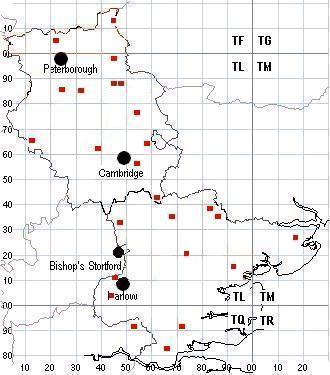
The 1km squares selected at random by the national survey co-ordinator are:

1km Square

Location

Volunteer found

Wider countryside map for Cambridgeshire & Essex
CAMBRIDGESHIRE

TF2105

Newborough, 2 miles NE of Peterborough


TL4498

Andrews Farm, 2 miles NE of March

NO


TL2486

Near Ramsey, 8 miles N of Huntingdon


TL3085

Just NE of Ramsey


TL4789

Manea, 5 miles NE of Chatteris


TL4989

Ouse Washes, 1 mile E of Manea


TL5373

Between Stretham & Soham, just W of Kingfishers Bridge


TL1166

Near Kimbolton, 5 miles NW of St. Neots


TL3962

Near Dry Drayton, 4 miles NW of Cambridge


TL5764

Just N of Swaffham Prior


TL5456

2 miles NE of Fulbourn


TL6142

Camps End, between Saffron Walden and Haverhill

 
ESSEX

TL4833

1 mile NE of Clavering

NO


TL6935

3 miles N of Finchingfield

NO


TL8339

W of Bulmer, 3 miles SW of Sudbury


TL8536

Between Sudbury and Halstead


TL4610

Mark Hall South area of Harlow


TQ5390

Harold Wood, Romford


TQ6682

Horndon on the Hill, Thurrock


TQ7091

N side of Basildon

 
TF2105 TL4498 TL2486 TL3085 TL4786 TL4989 TL5373 TL1166 TL3962 TL5764 TL5456 TL6142 TL4833 TL6935 TL8339 TL8536 TL4610 TQ5390 TQ6682 TQ7091

How to plan the survey

If you are a surveying a square that has been allocated to you, it will be necessary to establish a fixed survey route through the square. The survey route is two parallel 1-km long survey lines across your square (running N-S or E-W), that are subdivided into ten continuous 200m sections numbered 1-10.

  • Ideally, survey lines should be around 500m apart and 250m in from the edge of the square.
  • Because these squares may be re-surveyed in future years, it is important to note the starting points of each section either with the help of permanent landmarks (trees, hedges, boulders, houses etc) or by using temporary markers (coloured tape or cord etc).
  • In practice, your survey lines are likely to deviate from the 'ideal' because of problems with access, or barriers such as roads, rivers, and canals. In cases where the survey lines deviate considerably from the 'ideal', at no point should the two lines be closer together than 100m.
  • For each of the two survey lines, only record 1-km even if it means not reaching the edge of the square.
  • Minor intrusions into adjacent squares are perfectly acceptable and may provide the only practical way to carry out the survey. Indeed the route will be acceptable as long as more of the survey line falls within the square rather than outside.
  • It is advisable to make an initial visit to your 1-km square to familiarise yourself with the route.

Obtaining access to the survey route within squares

A large number of 1-km squares have paths, roads, bridleways or open access across them. This information can be gathered from an OS map and the open access website (www.countrysideaccess.gov.uk). Unless there is open access to your whole square then it is important that you contact the landowner to gain permission to carry out the survey visits. We advise contacting the nearest dwelling to your square either by telephoning to arrange a visit or by sending them a letter. A letter template is available which outlines the reasons why the surveys are being carried out and what they entail.

How to survey

  • For each square record butterflies along the two 1-km survey lines on the same day.
  • Walk each section at a slow, steady pace counting all butterflies seen within 2.5m either side of the survey line, 5m ahead and 5m from ground level up.
  • Try to avoid double counting where possible e.g. when an individual butterfly repeatedly flies in and out of your recording box. However, if you lose sight of an individual, and later regain sight of the same species do not assume this is the same individual.
  • Do not count butterflies behind you.

When to survey and recording criteria

  • A minimum of two visits to each square are required to take part in this survey and these should take place in July and August, with at least 10 days between the two visits.
  • In addition, one or two further visits can be made to the square during May, June, July or August with at least 10 days between visits.
  • If possible return visits to squares should be made at the same time of day.
  • Record the time at which you start and end each survey line (1-km) on the survey recording form.
  • Survey lines should generally be walked between 10.45am and 15.45pm and only when weather conditions are suitable for butterfly activity: dry conditions, wind speed less than Beaufort Scale 5 and temperature 13°C or greater if there is at least 60% sunshine, or more than 17°C if overcast.
  • If a distinct shadow is cast (bright cloud) then conditions may be classed as sunny.
  • If possible, sunshine should be estimated for each section to the nearest 10% of the time it was sunny while you were walking that section (shade cast by features such as trees does not count).
  • At the end of each survey visit, record shade temperature (e.g. with a portable thermometer placed in a shaded position at the beginning of the first survey line before you start), estimate average sunshine (based on section data), and average windspeed, using the following Beaufort Scale (see Table 1).

Exceptions to general recording rules:

  • It is also permissible to record from 09:30-10:45 and 15:45-16:30, if at these times the majority (>75%) of the survey area is unshaded and the standard (described above) weather criteria have been met.

Species identification

Try to identify and separate all species you encounter, including where possible similar species such as Small and Essex Skipper, and the 'cabbage' whites.

Co-ordinator Contacts

Further information will be made available in the coming months but if you are interested (no obligation!) please contact:

For Cambridgeshire Squares: Vince Lea or phone on 01223 263962

For Essex Squares: Paul Parmenter or phone on 01621 892935

top of page
 

All page content on this Web site is Copyright © 2000-2008 Butterfly Conservation unless otherwise stated
Legal Information
Butterfly Conservation is a Company limited by guarantee, registered in England (2206468)
Registered Office: Manor Yard, East Lulworth, Wareham, Dorset BH20 5QP
Charity registered in England & Wales (254937) and in Scotland (SCO39268)
VAT No. 565 9070 16